Bearded Chicken Breeds: A Bearded Farmer's Guide to Beards and Muffs
Guide to bearded chicken breeds: what beards and muffs are, which breeds carry them, and tips for Virginia backyard flocks.
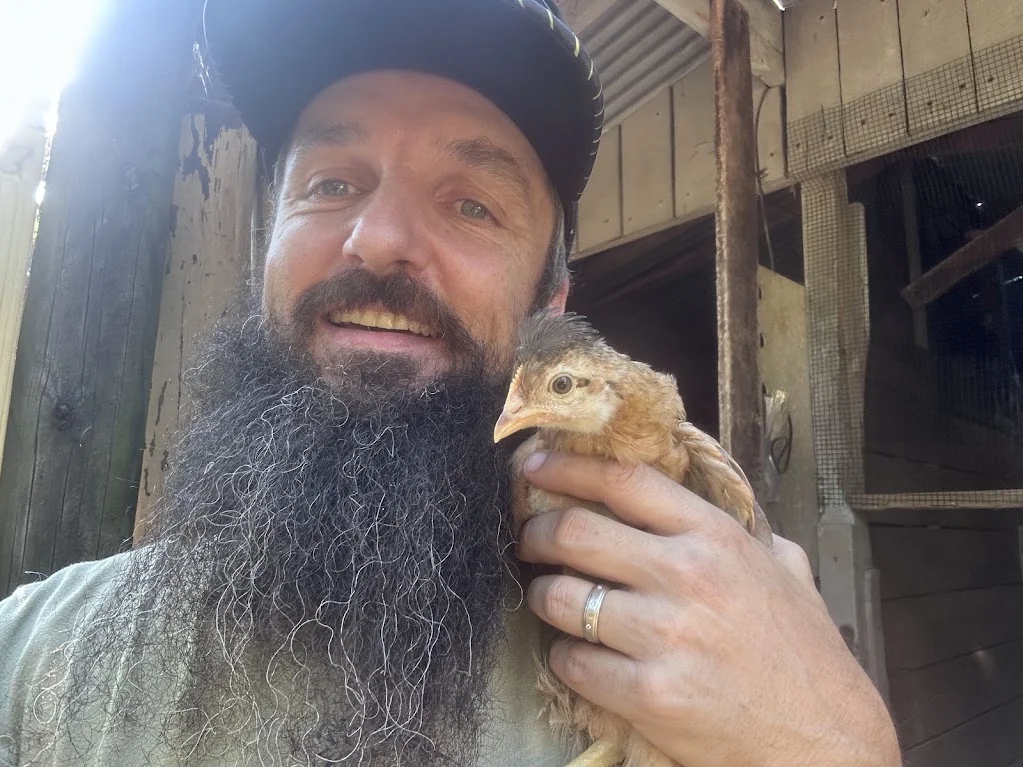
That's me up top, cap on and beard out, holding a baby Ameraucana chick by the coop. On a farm called Bearded Farms, it only seemed right to raise a bird that grows a beard of its own. Look close and you can see it starting: the little beard under the beak and the muffs at the cheeks are already coming in.
We get asked about bearded chickens more than you might expect, and it's a fair question. A good beard is a good beard, whether it's on a farmer or a hen. This guide covers what a beard on a chicken actually is, which bearded chicken breeds have one, and what to think about before you add one to a backyard flock.
Bearded Farms is in Sandston and serves families across New Kent County and Greater Richmond. For how we think about heritage birds in general, see our heritage chicken breeds overview.
What makes a bearded chicken
A bearded chicken has a tuft of longer feathers growing under the beak. Most bearded breeds also have muffs, which are fuller feathers that puff out from the cheeks. Together, the beard and muffs give the bird a full, whiskered face. In many birds they take the place of the dangling wattles you see on most chickens.
A beard is a breed trait, not something a bird grows with age the way a rooster grows spurs. If a chick comes from a bearded breed, the beard is part of the package.
Bearded chicken breeds worth knowing
These are breeds where beards and muffs are part of the breed description, either for the whole breed or for named bearded varieties.
Ameraucana
This is the breed in the photo up top, and the one we raise here at Bearded Farms. The Ameraucana was developed in the United States from South American blue egg chickens. Every color variety carries a beard and muffs, so the whiskered face is part of the breed, not a lucky few. The hens lay blue eggs.
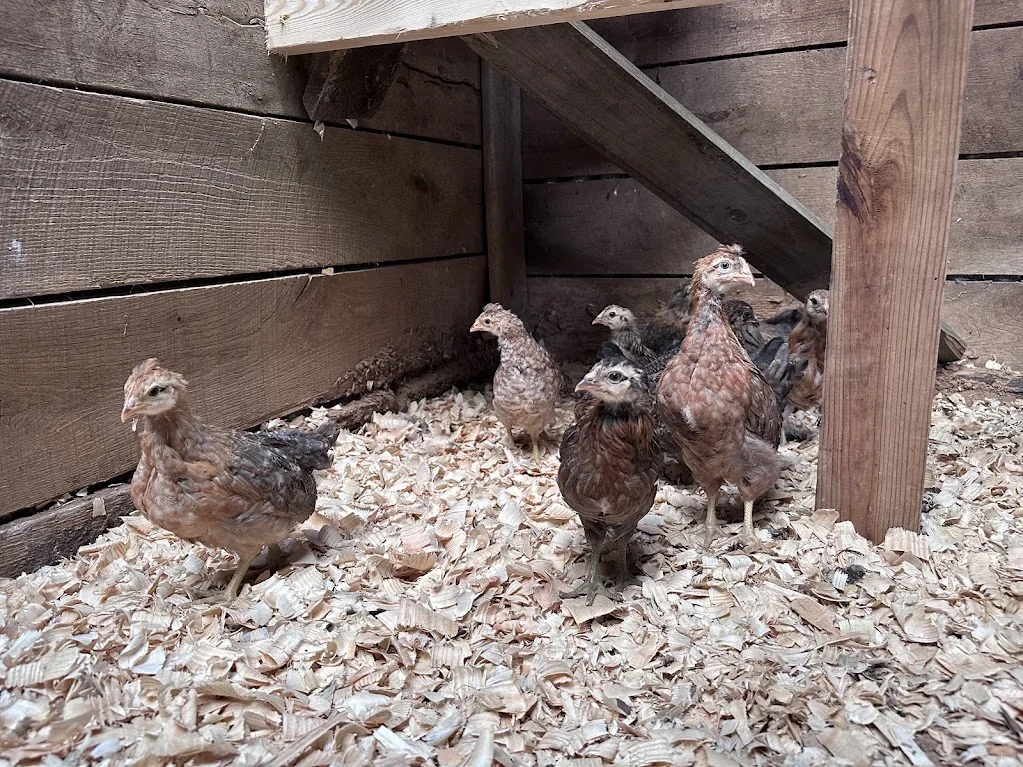
That chick has company. Here's the rest of our young Ameraucana flock, settled on pine shavings in the coop. The beard and muffs show up early. Even on a young chick like the one in my hand, you can see the fuller feathers filling in under the beak and along the cheeks.
If you see a bearded bird laying blue eggs, there's a good chance it's an Ameraucana or an Easter Egger. Easter Eggers often have beards too, but they are mixed birds, not a standardized breed.
Faverolles
Faverolles come from France. Along with a beard and muffs, they have lightly feathered legs and five toes on each foot instead of four. The Livestock Conservancy lists them as a dual purpose bird that is docile but active and lays tinted to light brown eggs.
Houdan
Another French breed, the Houdan has a beard, muffs, a crest of head feathers, a V-shaped comb, and five toes. The classic look is black mottled with white, and there is also a white variety. The Livestock Conservancy notes that the crest can block a Houdan's view, which makes it a breed that appreciates a well-covered run.
Crevecoeur
The Crevecoeur is the older French breed the Houdan was developed from. It is solid black, with a beard, muffs, a crest, and a V-shaped comb.
Belgian d'Uccle
The Belgian d'Uccle, often called the Belgian Bearded d'Uccle, is a true bantam, meaning there is no large version of the breed. The Livestock Conservancy describes beards and muffs that form one continuous line from the eyes over the earlobes, plus heavily feathered feet and vulture hocks. The Mille Fleur variety is the one most people picture.
Belgian d'Anvers
The d'Anvers, also known as the Antwerp Belgian or Bearded d'Anver, is the other Belgian true bantam. All of its color varieties carry a beard and muffs, but unlike the d'Uccle it has clean, unfeathered legs.
Sultan
The Sultan has about every ornament a chicken can wear: beard, muffs, crest, feathered legs and feet, vulture hocks, and five toes. It comes in white, black, and blue.
Polish and Silkie (bearded varieties)
Polish and Silkies each come in both bearded and non-bearded varieties. Polish are known for their big crests, and Silkies for their soft, fur-like feathers. If a beard matters to you, ask specifically for a bearded variety.
Living with bearded chickens
From a chore standpoint, a bearded chicken is mostly just a chicken. A few things are worth planning for:
- Waterers. Beards and muffs can dip into open water dishes and come out wet and messy. Many keepers prefer nipple or cup style waterers for bearded birds.
- Crests. Several bearded breeds, including the Houdan, Crevecoeur, Sultan, and Polish, also wear crests. A crest can limit what a bird sees, so a covered run and a calm approach help.
- Feathered feet. Breeds like the Faverolles, Belgian d'Uccle, and Sultan carry feathers on their legs or feet. Dry footing and fresh bedding after a rain keep those feathers in good shape. Our winter coop care notes cover keeping a coop dry through a Virginia winter.
- Bantams. The Belgian d'Uccle and d'Anvers are small birds. Plan housing and roost heights around their size.
Choosing a breed for your flock
Pick a breed for the eggs, temperament, and size you want first, and let the beard be the bonus. A bearded hen still has to fit your coop, your climate, and your routine. If you want a broader look at why traditional breeds suit backyard and pasture flocks, start with our heritage chicken breeds overview.
Our birds are sold out for this season, and heritage chicks are back next spring. Farm-fresh eggs are still available, and visits are by appointment only.
Questions about eggs or chicks in Sandston and New Kent County, VA? Text the farm.
Questions about eggs or chicks in Sandston and New Kent County, VA? .
Back to all posts